
Anterior Hip Replacement vs. Mini-Superior Hip Replacement
What the research shows, and why the Mini-Superior approach comes out ahead
Hip replacement is one of the most successful operations in medicine. There are several ways to reach the hip joint to remove arthritic cartilage and diseased bone. Two of them are designed to minimize trauma to the hip abductors, the muscles on the side of the hip that are critical for a normal walk and a speedy recovery. These are the anterior approach (through the front of the hip) and the Mini-Superior approach, Dr. Kang’s minimally invasive, posterior-based technique performed just behind the top of the thigh bone.
The anterior approach is heavily marketed, but the research tells a different story. Both approaches deliver the same long-term function. The difference is in the risks: the anterior approach carries well-documented problems with thigh numbness, wound healing, and early thigh-bone failure that the Mini-Superior largely avoids, and Mini-Superior patients need no hip precautions.1–5 Above all, a successful hip replacement depends on restoring normal anatomy (leg length, hip center, and offset) with well-positioned implants, and the Mini-Superior gives Dr. Kang a clear view of both the socket and the thigh bone to do exactly that.
Why the Mini-Superior comes out ahead
- Same long-term function. Randomized trials find no meaningful difference in pain or function from about 3 months onward, including a trial that followed patients for 7.5 years.4,6,7
- No outer-thigh numbness. Injury to the thigh’s skin nerve affected 16% to 83% of anterior patients in randomized trials. This nerve is not in the Mini-Superior surgical field.8,9
- Fewer wound problems, especially in heavier patients.2
- Fewer thigh-bone complications. Large registries show more stem loosening and early femoral failure after anterior surgery.3,10
- No hip precautions, a practice now backed by large randomized trials.5,11
- A very stable hip. Soft-tissue repair has brought posterior dislocation rates below 1% in recent trials,5,12,13 and Dr. Kang’s piriformis-preserving technique with a capsular noose repair adds further stability.
- No radiation to the genital area from X-ray during surgery.
- Any anterior “head start” is small: in trials, anterior patients set aside walking aids about a week sooner, and the difference disappeared within weeks.14–16
What is the Mini-Superior hip replacement?
The Mini-Superior is a minimally invasive, posterior-based hip replacement. The approach was originally developed by Todd Swanson, M.D., and Dr. Kang has made substantial modifications to it over the years. In the research literature, this family of techniques is called the “mini-posterior” approach. The posterior approach is the most commonly used approach for hip replacement in Australia’s national joint registry and in the Kaiser Permanente registry in the United States.3,10
Through an incision of about 8 cm on the side of the hip, just behind the top of the thigh bone, the large buttock muscle (gluteus maximus) is split along the direction of its fibers rather than cut. The abductor muscles (gluteus medius and minimus), which power a normal walk, stay attached. Dr. Kang’s technique preserves the piriformis tendon, and at the end of the operation the joint capsule is closed with a capsular noose repair. Research shows that repairing the soft tissues at the back of the hip reduces dislocation dramatically,12 and in Dr. Kang’s experience, preserving the piriformis and using a noose repair lowers the dislocation rate even further.
Neither approach removes any muscle, and the anterior approach is not the gentle, “muscle-free” operation it is often advertised to be. In a cadaver study, the anterior approach damaged on average 31% of the tensor fascia lata muscle and 12% of the rectus femoris, and the surgeons had to cut the piriformis or neighboring rotator tendons in half of the hips just to free the thigh bone. The standard posterior approach tested in that study detached the piriformis and other rotator tendons and caused some damage to the gluteus minimus.17 Dr. Kang’s Mini-Superior is designed to preserve the piriformis.
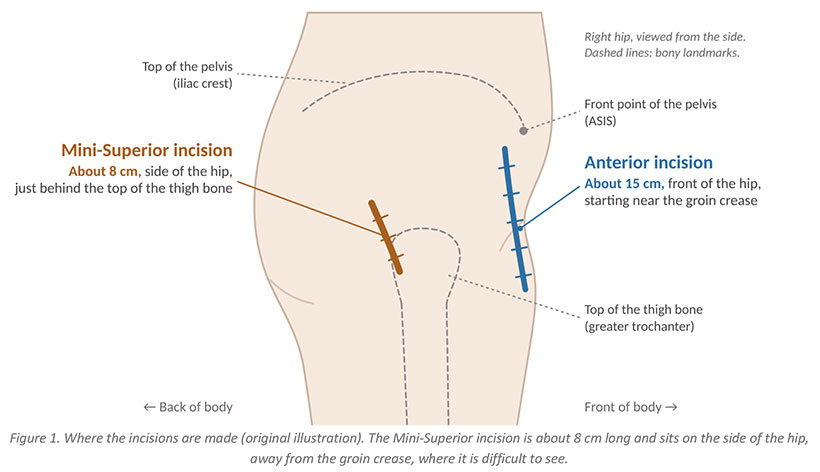
Side-by-side comparison
Superscript numbers refer to the references at the end of this page.
| Anterior | Mini-Superior | Advantage | |
|---|---|---|---|
| Incision | About 15 cm on the front of the hip, starting near the groin crease | About 8 cm on the side of the hip, just behind the top of the thigh bone; the scar is difficult to see | ✓ Mini-Superior |
| Muscles | Works between muscles, but front thigh muscles are stretched and can be damaged; rotator tendons are sometimes cut to free the thigh bone17 | Gluteus maximus split along its fibers; abductors stay attached; piriformis preserved | ✓ Mini-Superior |
| Thigh numbness (lateral femoral cutaneous nerve) | Common: 16% to 83% of patients in randomized trials that checked for it8,9 | Rare: the nerve is not near the incision1,9 | ✓ Mini-Superior |
| Wound-healing problems | More frequent, especially in heavier patients2,18; some require a return to the operating room4 | Less frequent2; simple wound care is usually all that is needed | ✓ Mini-Superior |
| Thigh-bone (femur) complications | Higher rates of stem loosening and early femoral failure requiring revision3,10,19 | Lower rates3,19 | ✓ Mini-Superior |
| Radiation during surgery | Live X-ray (fluoroscopy) is commonly used to position the socket, exposing the pelvis and genitals to radiation20,21 | No routine X-ray during surgery; no added radiation to the genital area | ✓ Mini-Superior |
| Hip precautions | No posterior precautions; occasional anterior precautions | None; randomized trials show precautions are not needed5,11,13 | ✓ Mini-Superior |
| Heavier patients (higher BMI) | Wound risk climbs with weight, most sharply above a BMI of about 332 | Wound problems are less common overall than with the anterior incision2 | ✓ Mini-Superior |
| Complex hips (prior surgery, hardware, deformity) and revisions | More limited exposure; revisions of anterior hips usually switch to a different approach22 | Can be extended through the same incision; favored for complex and revision surgery23 | ✓ Mini-Superior |
| Operating time | About 15 minutes longer on average24,25 | Shorter on average24,25 | ✓ Mini-Superior |
| Dislocation | Low; registries show slightly fewer dislocations than with traditional posterior approaches3,10 | Low: under 1% in recent posterior-approach trials,5,13 with added stability from piriformis preservation and capsular noose repair | Both low |
| Time to normal walking | About 7 to 24 days | About 10 to 21 days | Similar |
| Pain and function at 3 months and beyond | Same | Same4,6,7 | Same |
| Hospital stay | Outpatient or overnight | Outpatient or overnight26 | Same |
What the research shows
1. No thigh numbness
The lateral femoral cutaneous nerve supplies feeling to the outer thigh, and it runs right through the anterior surgical field. Stretching or injuring it causes numbness, tingling, or burning over the outer thigh. In randomized trials that specifically checked for it, this occurred in 16% to 83% of anterior patients, compared with none of the posterior patients in the trial that reported both groups.8,9 A pooled analysis of randomized trials found nerve injury many times more common with the anterior approach.1 Most cases improve over time,27 but some persist, and some patients need injections or surgery on the nerve to relieve symptoms.28 This nerve is not in the Mini-Superior surgical field.
2. Fewer wound problems, especially in heavier patients
The anterior incision begins near the groin crease, where a skin fold can overhang the wound in heavier patients. In a multicenter study of more than 17,000 hip replacements, wound complications within 90 days were more common after anterior surgery (3.6% vs. 2.6%), and the risk climbed most sharply above a BMI of 33.2 Obesity is the most frequently identified risk factor for wound problems after anterior hip replacement,18 and the American Academy of Orthopaedic Surgeons (AAOS) 2023 guideline specifically lists an increased risk of wound complications with the anterior approach.29 Wound problems matter because they can lead to far more serious trouble: in a 10-year anterior series, patients with wound complications had much higher rates of deep infection and revision surgery.30
3. Fewer thigh-bone complications
Reaching the thigh bone through the front of the hip is the most technically demanding step of anterior surgery, and the registries show the consequences. In Australia’s national registry of 122,345 hip replacements, the anterior approach had higher rates of revision for thigh-bone fracture and stem loosening, and more major revisions, than the posterior approach.3 In the Kaiser Permanente registry in the United States, anterior hips had more than twice the risk of revision for loosening.10 In a multicenter study of hips revised within five years for early thigh-bone failure, 51% had been done through the anterior approach and only 14% through the posterior approach.19 The Dutch national registry likewise found more stem revisions after anterior surgery.31
4. No hip precautions
For decades, patients were told to avoid bending past 90 degrees, crossing their legs, or turning the foot inward for six weeks after posterior hip replacement. These “hip precautions” have now been tested directly, and they are not needed.
In a 2026 randomized trial of 1,133 patients who had posterior hip replacement with capsular repair, dislocation rates were the same with or without precautions, and patients without precautions reported better hip function at 6 weeks and at 3 to 6 months.5 Earlier randomized trials found no increase in dislocation without precautions,13,32,33 and one found that patients without precautions had less difficulty with daily activities, returned to driving sooner, and spent more time sleeping on their side.13 Meta-analyses pooling these trials conclude that routine precautions are not needed.11,34 Dr. Kang’s Mini-Superior patients follow no hip precautions.
5. A very stable hip
A dislocation occurs when the ball of the new hip comes out of its socket. Older posterior techniques had higher dislocation rates, but modern technique has changed that:
- Soft-tissue repair. Repairing the tissues at the back of the hip made an eightfold difference in a pooled analysis: dislocation fell from 4.46% without repair to 0.49% with repair.12
- Larger implant heads. In the Dutch national registry, 36 mm heads further lowered the risk of revision for dislocation with the posterior approach, without raising the risk of revision for other reasons.31
- Piriformis preservation and capsular noose repair. Dr. Kang’s modifications keep the piriformis intact and close the capsule with a noose repair, which in his experience lowers the dislocation rate even further.
Pooled data put the repaired posterior dislocation rate around 0.5%, comparable to the roughly 0.6% reported for the anterior approach.12,35 Two recent randomized trials of modern posterior hip replacement reported overall dislocation rates of 0.85% and 0.88%.5,13 Large registries, which group all posterior techniques together, record slightly fewer dislocations after anterior surgery,3,10 but those same registries show the anterior approach trades this for more thigh-bone complications, and overall revision rates do not differ.3,36
6. Recovery: any anterior head start is small and short-lived
Anterior hip replacement is often marketed as offering a dramatically faster recovery. Randomized trials, the strongest type of clinical study, do not support that claim. In the most cited trial, from the Mayo Clinic, anterior patients set aside all walking aids about a week sooner than mini-posterior patients (17 vs. 24 days), but there were no substantive differences by two months.14 At 7.5 years, the trial found no meaningful differences in outcomes, complications, reoperations, or revisions.4 Pooled analyses agree: slightly less pain in the first few days and slightly better scores at 2 to 6 weeks with the anterior approach, then no meaningful differences from about 3 months onward.6,7,24
These trials compared the anterior approach with standard mini-posterior techniques, not with Dr. Kang’s modified Mini-Superior. Dr. Kang’s patients typically return to normal walking in 10 to 21 days, without hip precautions.
Why some claims sound bigger. Many studies that report large anterior benefits are not randomized. In those studies, surgeons may choose the anterior approach for younger, thinner, healthier patients, who recover quickly with any approach, and reserve the posterior approach for heavier or more complex patients. The difference then reflects the patients rather than the operation. A 2026 review noted that observational comparisons of the two approaches are limited mainly by this kind of confounding.37
7. Built for complex hips, without a learning-curve penalty
The anterior approach has a well-documented learning curve: Australian registry data showed that revision rates did not settle until a surgeon had performed more than 50 anterior hip replacements.38 The posterior approach can be extended through the same incision when more exposure is needed, which is why it remains favored for revisions and complex reconstructions.23 When an anterior hip needs revision, surgeons usually switch to a different approach (72% of cases in one series).22
8. No radiation to the genital area during surgery
Because the patient lies on their back, anterior surgeons commonly use live X-ray (fluoroscopy) during the operation to help position the socket.20 The X-ray beam is centered on the pelvis, so this adds radiation exposure to the pelvis and genital area.21 The Mini-Superior does not require routine X-ray during surgery.
Why Dr. Kang chooses the Mini-Superior approach
Dr. Kang has performed and refined the Mini-Superior approach over many years because it gives his patients the best overall result:
- No outer-thigh numbness, a common problem after anterior surgery.
- Fewer wound problems and fewer thigh-bone complications than the anterior approach.
- A very stable hip without precautions, thanks to piriformis preservation and a capsular noose repair. Patients can move naturally as they recover.
- No radiation to the genital area from X-ray during surgery.
- It works for nearly every patient, regardless of body type, prior surgery, or anatomy, and the incision can be extended when a complex hip needs more room.
- A clear view of both the socket and the thigh bone, which supports the most important goal of any hip replacement: restoring leg length, hip center, and offset with well-positioned implants.
- Fast, modern recovery: outpatient or overnight stay, normal walking typically within 10 to 21 days, and the same long-term function as anterior hip replacement.
Questions to ask any hip surgeon
The AAOS guideline recommends that the choice of approach rest on the surgeon’s training and experience.29 Whatever approach you are considering, it is reasonable to ask:
- How many hip replacements do you perform each year with this approach?
- What are your dislocation and infection rates?
- How often do your patients have numbness of the outer thigh?
- Will X-ray be used during my surgery?
- Will I need hip precautions after surgery?
- How do you make sure my leg length and implant position are correct?
This page is for general education and does not replace a personal consultation. Individual risks depend on your health, anatomy, and surgical history.
References
- Yang XT, et al. Direct anterior approach versus posterolateral approach in total hip arthroplasty: a systematic review and meta-analysis of randomized controlled studies. Orthop Surg. 2020;12(4):1065-1073. PMID 32558261. doi:10.1111/os.12669
- Salmons HI, et al. Surgical approach and body mass index impact risk of wound complications following total hip arthroplasty. J Arthroplasty. 2024;39(9 Suppl 2):S459-S463. PMID 38548235. doi:10.1016/j.arth.2024.03.047
- Hoskins W, et al. Early rate of revision of total hip arthroplasty related to surgical approach: an analysis of 122,345 primary total hip arthroplasties. J Bone Joint Surg Am. 2020;102(21):1874-1882. PMID 32769807. doi:10.2106/JBJS.19.01289
- Roberts HJ, et al. A randomized clinical trial of direct anterior versus mini-posterior total hip arthroplasty: small, early functional differences did not lead to meaningful clinical differences at 7.5 years. J Arthroplasty. 2024;39(9 Suppl 1):S97-S100. PMID 38735544. doi:10.1016/j.arth.2024.05.016
- Yadav AS, et al. Do hip precautions matter after posterior approach total hip arthroplasty with capsular repair? A randomized control trial. J Arthroplasty. 2026;41(9S1):S324-S328. PMID 42055222. doi:10.1016/j.arth.2026.04.080
- Wang Z, et al. A systematic review and meta-analysis of direct anterior approach versus posterior approach in total hip arthroplasty. J Orthop Surg Res. 2018;13(1):229. PMID 30189881. doi:10.1186/s13018-018-0929-4
- Nassar JE, et al. Direct anterior approach and posterior approach for total hip arthroplasty: a systematic umbrella review of meta-analyses of randomized controlled trials. Orthop Rev (Pavia). 2025;17:137665. PMID 40416593. doi:10.52965/001c.137665
- Bon G, et al. Does the direct anterior approach allow earlier recovery of walking following total hip arthroplasty? A randomized prospective trial using accelerometry. Orthop Traumatol Surg Res. 2019;105(3):445-452. PMID 30853454. doi:10.1016/j.otsr.2019.02.008
- Cheng TE, et al. A prospective randomized clinical trial in total hip arthroplasty: comparing early results between the direct anterior approach and the posterior approach. J Arthroplasty. 2017;32(3):883-890. PMID 27687805. doi:10.1016/j.arth.2016.08.027
- Charney M, et al. A comparison of risk of dislocation and cause-specific revision between direct anterior and posterior approach following elective cementless total hip arthroplasty. J Arthroplasty. 2020;35(6):1651-1657. PMID 32057597. doi:10.1016/j.arth.2020.01.033
- Guo J, et al. No need for hip precautions after total hip arthroplasty with posterior approach: a systematic review and meta-analysis. Medicine (Baltimore). 2024;103(50):e40348. PMID 39686472. doi:10.1097/MD.0000000000040348
- Kwon MS, et al. Does surgical approach affect total hip arthroplasty dislocation rates? Clin Orthop Relat Res. 2006;447:34-38. PMID 16741471. doi:10.1097/01.blo.0000218746.84494.df
- Tetreault MW, et al. Are postoperative hip precautions necessary after primary total hip arthroplasty using a posterior approach? Preliminary results of a prospective randomized trial. J Arthroplasty. 2020;35(6S):S246-S251. PMID 32146109. doi:10.1016/j.arth.2020.02.019
- Taunton MJ, et al. John Charnley Award: Randomized clinical trial of direct anterior and miniposterior approach THA: which provides better functional recovery? Clin Orthop Relat Res. 2018;476(2):216-229. PMID 29529650. doi:10.1007/s11999.0000000000000112
- Taunton MJ, et al. Direct anterior total hip arthroplasty yields more rapid voluntary cessation of all walking aids: a prospective, randomized clinical trial. J Arthroplasty. 2014;29(9 Suppl):169-172. PMID 25007723. doi:10.1016/j.arth.2014.03.051
- Christensen CP, Jacobs CA. Comparison of patient function during the first six weeks after direct anterior or posterior total hip arthroplasty (THA): a randomized study. J Arthroplasty. 2015;30(9 Suppl):94-97. PMID 26096071. doi:10.1016/j.arth.2014.12.038
- Meneghini RM, et al. Muscle damage during MIS total hip arthroplasty: Smith-Petersen versus posterior approach. Clin Orthop Relat Res. 2006;453:293-298. PMID 17006366. doi:10.1097/01.blo.0000238859.46615.34
- Subramanian T, et al. Systematic review of wound complications after direct anterior approach total hip arthroplasty: incidence, risk factors, and management strategies. J Am Acad Orthop Surg. 2026;34(19):e2736-e2752. PMID 42224471. doi:10.5435/JAAOS-D-25-01035
- Meneghini RM, et al. Direct anterior approach: risk factor for early femoral failure of cementless total hip arthroplasty: a multicenter study. J Bone Joint Surg Am. 2017;99(2):99-105. PMID 28099299. doi:10.2106/JBJS.16.00060
- Jinnai Y, et al. Does a fluoro-assisted direct anterior approach for total hip arthroplasty pose an excessive risk of radiation exposure to the surgeon? SICOT J. 2020;6:6. PMID 32068533. doi:10.1051/sicotj/2020004
- Costello JP, et al. Accuracy and safety of acetabular cup placement in total hip arthroplasty using mixed-reality navigation: a prospective trial. J Orthop. 2026;75:262-267. PMID 41768850. doi:10.1016/j.jor.2026.02.010
- Harmer JR, et al. Changing surgical approach from primary to revision total hip arthroplasty is not associated with increased risk of dislocation or re-revisions. J Arthroplasty. 2022;37(7S):S622-S627. PMID 35276276. doi:10.1016/j.arth.2022.03.007
- Dimitriu AL, et al. Comparative analysis of surgical approaches in total hip arthroplasty: a systematic review of comparative outcomes including primary and revision cases. J Orthop Surg Res. 2026;21(1):116. PMID 41540450. doi:10.1186/s13018-025-06629-8
- Liu R, et al. Comparative efficacy of direct anterior approach versus conventional surgical approaches in total hip arthroplasty: a systematic review and meta-analysis of randomized clinical trials. J Orthop Surg Res. 2025;20(1):837. PMID 41013681. doi:10.1186/s13018-025-06227-8
- Ang JJM, et al. Comparing direct anterior approach versus posterior approach or lateral approach in total hip arthroplasty: a systematic review and meta-analysis. Eur J Orthop Surg Traumatol. 2023;33(7):2773-2792. PMID 37010580. doi:10.1007/s00590-023-03528-8
- Dove JH, et al. The effect of surgical approach on the outcomes of same-day discharge outpatient total hip arthroplasty at a single ambulatory surgery center. J Arthroplasty. 2024;39(2):398-401. PMID 37595765. doi:10.1016/j.arth.2023.08.034
- Butler J, et al. Bikini incision vs longitudinal incision for anterior total hip arthroplasty: a systematic review. Arthroplast Today. 2022;17:1-8. PMID 35942107. doi:10.1016/j.artd.2022.06.010
- Hax J, et al. Treatment options for persistent lateral femoral cutaneous nerve lesions after total hip arthroplasty via the direct anterior approach: retrospective analysis with clinical assessment. Int Orthop. 2025;49(5):1107-1117. PMID 40140107. doi:10.1007/s00264-025-06512-5
- American Academy of Orthopaedic Surgeons. Management of Osteoarthritis of the Hip: Evidence-Based Clinical Practice Guideline. Published December 1, 2023. Summary: AAOS Now, February 2024. https://aaos.org/aaosnow/2024/feb/research/research03
- Schaffler BC, et al. Risk factors for wound complications in direct anterior total hip arthroplasty: a 10-year analysis. Hip Int. 2026 (online ahead of print). PMID 42584179. doi:10.1177/11207000261467289
- Zijlstra WP, et al. Effect of femoral head size and surgical approach on risk of revision for dislocation after total hip arthroplasty. Acta Orthop. 2017;88(4):395-401. PMID 28440704. doi:10.1080/17453674.2017.1317515
- Mounts MR, et al. Patients achieving 90°/45°/0° intraoperative stability do not require hip precautions following posterior approach total hip arthroplasty: a prospective randomized study. J Arthroplasty. 2022;37(8S):S876-S880. PMID 35093547. doi:10.1016/j.arth.2022.01.028
- Dietz MJ, et al. Posterior hip precautions do not impact early recovery in total hip arthroplasty: a multicenter, randomized, controlled study. J Arthroplasty. 2019;34(7S):S221-S227. PMID 30975478. doi:10.1016/j.arth.2019.02.057
- Korfitsen CB, et al. Hip precautions after posterior-approach total hip arthroplasty among patients with primary hip osteoarthritis do not influence early recovery: a systematic review and meta-analysis of randomized and non-randomized studies with 8,835 patients. Acta Orthop. 2023;94:141-151. PMID 37039064. doi:10.2340/17453674.2023.11958
- De Geest T, et al. Adverse effects associated with the direct anterior approach for total hip arthroplasty: a Bayesian meta-analysis. Arch Orthop Trauma Surg. 2015;135(8):1183-1192. PMID 26081800. doi:10.1007/s00402-015-2258-y
- Ghandour M, et al. Direct anterior approach versus posterior approach in total hip arthroplasty: a systematic review and meta-analysis. J Orthop. 2025;65:233-250. PMID 40607318. doi:10.1016/j.jor.2025.06.007
- Movva S, et al. Clinical and safety outcomes after direct anterior total hip arthroplasty compared with conventional approaches: a systematic review and meta-analysis. J Orthop Case Rep. 2026;16(3):413-428. PMID 41815679. doi:10.13107/jocr.2026.v16.i03.7006
- de Steiger RN, Lorimer M, Solomon M. What is the learning curve for the anterior approach for total hip arthroplasty? Clin Orthop Relat Res. 2015;473(12):3860-3866. PMID 26394641. doi:10.1007/s11999-015-4565-6